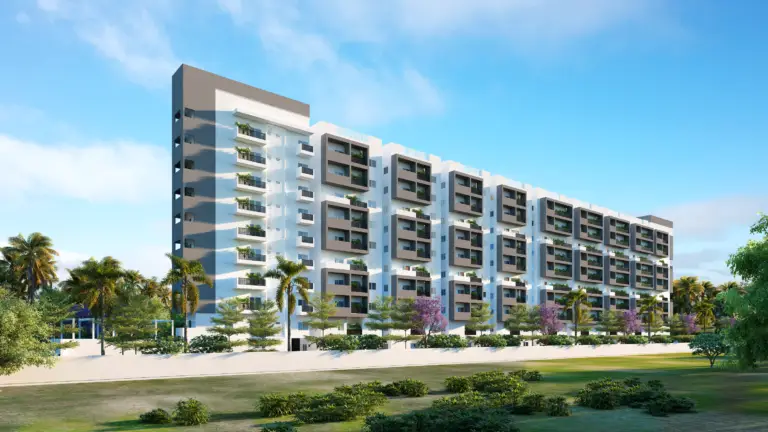


Why Whitefield, Bengaluru Is the Smartest Real Estate Investment in 2026
There’s a reason Whitefield keeps coming up in every conversation about Bengaluru real estate — whether you’re an IT professional buying your first home, a mid-career executive upgrading to a larger flat, or an NRI looking for a trusted Rupee investment.
The fundamentals here are unusually strong. Employment is concentrated and growing. Infrastructure has improved dramatically. And the Metro, once a long-promised project, is now operational — reshaping price dynamics across the entire corridor.
But not all of Whitefield is equal. And 2025 is not the same market as 2021. This guide breaks down why Whitefield remains Bengaluru’s best real estate bet — and exactly where the opportunity sits today.
Table of Contents
- What Makes Whitefield an IT Hub — and Why That Matters for Property
- The Metro Effect: How Purple Line Changed the Equation
- Whitefield Property Price Trends: 2020–2025
- Rental Yield Analysis: What Investors Actually Earn
- Micro-Market Breakdown: Where to Buy in 2025
- Who Should Invest in Whitefield? (Buyer Personas)
- Risks to Know Before You Invest
- How Diligent Enterprises Helps You Invest Smartly
- FAQ: Whitefield Real Estate Investment
What Makes Whitefield an IT Hub — and Why That Matters for Property
Whitefield’s identity as a technology corridor isn’t incidental — it was systematically built. The Export Promotion Industrial Park (EPIP Zone) in the 1990s seeded the first wave of IT companies. The International Tech Park Bangalore (ITPL), one of India’s earliest IT SEZs, established Whitefield’s global profile. Today, the zone has evolved into a multi-layered tech ecosystem spread across 25+ square kilometres.
Scale of the IT corridor (2026 data):
- 300,000+ professionals employed in Whitefield and adjacent tech parks
- 200+ companies with major offices, including Wipro (global HQ), TCS, IBM, Infosys, SAP, Oracle, Bosch, and EPAM
- 10 million+ sq. ft. of Grade A commercial office space
- 15+ IT SEZs and tech parks operational within a 5 km radius of Whitefield Main Road
This scale of employment directly produces two things that make real estate perform: sustained rental demand and steady buyer demand from stable, high-income earners. Unlike markets driven by speculation, Whitefield’s property demand is grounded in the employment base of one of the world’s largest tech economies.
When a company like Bosch or SAP expands its Bengaluru headcount, it isn’t adding 50 employees — it’s adding 500 to 2,000. Every one of those hires is a potential renter or buyer in the Whitefield catchment.
The Metro Effect: How Purple Line Changed the Equation
The single most transformative infrastructure development in Whitefield in a decade has been the extension of Namma Metro’s Purple Line to Kadugodi (Whitefield station), which became operational in phases through 2024.
What the Metro Changed
Before metro: Whitefield was semi-isolated. Peak-hour commutes to MG Road or Indiranagar took 60–90 minutes by road. This capped demand primarily to professionals working within Whitefield.
After metro: Travel time to MG Road dropped to 35–40 minutes. Connectivity to Majestic (central interchange), KR Puram, and the entire east-west corridor opened up. Whitefield is now commutable for professionals working anywhere on the Purple Line.
Measurable Price Impact
Properties within 800 metres of a metro station in Whitefield have recorded 10–15% price premium compared to equivalent projects further from stations. The Whitefield, Hoodi, and Kadugodi metro stations have each created their own micro-market demand rings.
For investors, metro proximity is now a primary valuation driver — and projects that were undervalued pre-metro have seen above-average appreciation since operations began.
Whitefield Property Price Trends: 2020–2026
The post-pandemic period has been one of the most active appreciation cycles in Whitefield’s history — driven by pent-up demand, returning NRI interest, and the infrastructure maturation of the corridor.
Average Residential Price Per Sq. Ft. — Whitefield
| Year | Average Price (₹/sq. ft.) | YoY Change |
|---|---|---|
| 2020 | ₹5,200 | Flat (COVID impact) |
| 2021 | ₹5,500 | +5.8% |
| 2022 | ₹6,100 | +10.9% |
| 2023 | ₹6,900 | +13.1% |
| 2024 – 25 | ₹7,800 | +13.0% |
| 2026 (est.) | ₹8,500–₹9,800 | +9–12% (mid-year projection) |
Note: Figures represent blended average across mid-to-premium residential segments. Luxury and metro-adjacent properties may command significantly higher rates.
What’s Driving Continued Appreciation in 2026
Tech sector stability: Despite global layoffs in 2023, Bengaluru’s tech employment base remained resilient. New GCC (Global Capability Centre) setups — over 1,700 GCCs are now based in India, with a significant share in Bengaluru — continue to add white-collar employment.
Supply-demand gap: Approved residential supply in Whitefield has not kept pace with demand. RERA data shows strong project launches but absorption rates have consistently outpaced new inventory.
Rental market tightness: Average 2 BHK rents in prime Whitefield localities rose from ₹22,000–₹26,000/month (2022) to ₹32,000–₹42,000/month (2026) — a 45–55% increase in three years. This signals acute housing demand that continues to underpin capital values.
Rental Yield Analysis: What Investors Actually Earn
Rental yield is the annual rental income expressed as a percentage of property value. In most Indian metros, yields of 2–3% are common. Whitefield consistently outperforms this benchmark.
Current Rental Yield Snapshot — Whitefield (2026)
| Property Type | Purchase Price | Monthly Rent | Gross Annual Yield |
|---|---|---|---|
| 2 BHK (1,100 sq. ft., ITPL Road) | ₹95 lakh | ₹36,000 | 4.5% |
| 2 BHK (1,000 sq. ft., Kannamangala) | ₹72 lakh | ₹26,000 | 4.3% |
| 3 BHK (1,600 sq. ft., Hoodi) | ₹1.4 crore | ₹52,000 | 4.5% |
| 1 BHK (600 sq. ft., near Metro) | ₹50 lakh | ₹20,000 | 4.8% |
Net yield (after maintenance, vacancy, and property tax) typically lands at 3.2–3.8% — still among the best in any major Indian city for residential property.
Combined with 10–13% capital appreciation, the total annual return on a well-chosen Whitefield property in 2026 is estimated at 13–17% — comparable to many equity investments, with significantly lower volatility.
Micro-Market Breakdown: Where to Buy in 2026
Whitefield is large enough to have meaningfully different micro-markets. Here’s an honest assessment of each.
Kannamangala — Best Value for Growth
Why it stands out: Kannamangala sits on the northeastern fringe of Whitefield, along the Whitefield-Hoskote Road. It benefits from Whitefield’s IT employment base while still offering prices 20–25% below the ITPL corridor.
- Price range: ₹5,800–₹7,500/sq. ft.
- Appreciation (2023–2026): 16–20% — among the highest in the zone
- Rental demand: Strong from mid-level IT professionals and couples
- Infrastructure: Multiple new residential projects, improved road access, upcoming civic amenities
- Best for: First-time buyers, value investors, 5–7 year horizon
ITPL Road & Kadugodi — Metro Premium, Established Demand
Why it stands out: Directly served by the Whitefield Metro station. Proximity to ITPL, Wipro headquarters, and multiple Grade A IT parks makes this the most liquid sub-market in the zone.
- Price range: ₹7,500–₹9,500/sq. ft.
- Appreciation (2023–2026): 12–15%
- Rental demand: Very high — lowest vacancy rates in Whitefield
- Best for: Investors prioritising yield and exit liquidity, end-users at senior IT roles
Varthur & Marathahalli Fringe — Connectivity Play
Why it stands out: Connects Whitefield to the Outer Ring Road tech corridor, giving access to two employment hubs. Slightly noisier, more commercial feel, but strong rental demand.
- Price range: ₹6,500–₹8,500/sq. ft.
- Best for: Buyers who work in both Whitefield and ORR-corridor companies
Hoodi & KR Puram Extension — Mature, Stable
Why it stands out: An older, more established micro-market. Lower appreciation upside but strong rental stability and good social infrastructure (schools, hospitals, malls).
- Price range: ₹5,500–₹7,000/sq. ft.
- Best for: Families prioritising liveability over investment return; buyers on tighter budgets

Who Should Invest in Whitefield?
Whitefield is not a one-size-fits-all market. Here’s who it genuinely works for — and why.
IT Professionals (₹18–60 LPA income range)
You’re paying ₹25,000–₹42,000/month in rent. Your EMI on a 2 BHK in Kannamangala would be roughly ₹58,000–₹68,000. The net additional outflow compared to renting is ₹16,000–₹26,000/month — in exchange for building equity in an asset that has appreciated 12%+ annually. The math has rarely been more compelling.
Mid-Career Professionals Upgrading
If you own a smaller flat purchased 5–8 years ago and are considering an upgrade, 2025 is a strong entry window for 3 BHK units before prices clear the ₹2 crore mark in established localities.
NRI Investors
Whitefield offers something NRIs value above everything else: exit liquidity. The depth of demand means you won’t struggle to find a buyer or tenant, even remotely managed. The Rupee-denominated returns with potential currency upside make this an attractive destination for diaspora capital.
Senior Executives & C-Suite Buyers
Luxury 3 and 4 BHK projects in Whitefield — particularly gated communities with premium amenities — are appreciating faster than the broader market. The quality of residential communities here rivals anything available in South Bengaluru, at a better price-to-quality ratio.
Risks to Know Before You Invest
Honest advisory means disclosing what can go wrong — not just what can go right.
Builder delivery risk
Under-construction projects carry the risk of delays. Bengaluru has seen projects slip 12–24 months past promised dates. Mitigation: Only buy from builders with at least 2 delivered projects in the city, and verify delay penalty clauses in the builder-buyer agreement.
Infrastructure development lag
While Whitefield’s core is well-served, peripheral micro-markets like outer Kannamangala still lack complete civic infrastructure (reliable water supply, road finishing). This is expected to resolve within 2–4 years as civic investment catches up with residential growth — but buyers should account for a transition period.
Project-specific legal risk
Land title disputes, encumbrances, and outdated approvals affect a minority of projects — but the consequences are severe. A legal title check by a qualified property lawyer before booking is non-negotiable.
Market timing
Whitefield prices have appreciated sharply. While fundamentals support continued growth, buyers who need to exit within 2–3 years face more risk than those with a 5–7 year horizon. Real estate is a medium-term asset class.
How Diligent Enterprises Helps You Invest Smartly
Navigating a market as active as Whitefield requires more than a property search portal. It requires someone who knows which projects are financially sound, which builders deliver, and which localities are positioned for the next wave of appreciation.
Diligent Enterprises brings 7 years of active presence in the Whitefield and East Bengaluru market, with a portfolio of 50+ vetted projects and 1,500+ clients who have purchased through us.
What we do for investors:
- Shortlist only RERA-approved projects from builders with proven delivery records
- Provide independent price benchmarking — so you never overpay
- Negotiate preferred pricing and unit selection on your behalf
- Assist with home loan processing across 10+ banking partners
- Offer post-purchase property management and rental assistance through our dedicated team
There is no buyer-side fee. Our service is fully funded by the developer — so you receive expert, independent advisory at zero additional cost.
FAQ: Whitefield Real Estate Investment
Q1: Is 2026 a good time to invest in property in Whitefield?
Yes — with context. Whitefield prices have appreciated significantly since 2022, so the easy-entry phase has passed. However, fundamentals remain strong: employment growth, metro connectivity, and a structural housing deficit continue to support values. Buyers with a 5–7 year horizon are well-positioned. Short-term speculative plays carry more risk at current price levels.
Q2: What is the average price per sq. ft. in Whitefield in 2026?
The blended average for mid-to-premium residential projects in Whitefield ranges from ₹7,200 to ₹9,800 per sq. ft., depending on micro-location, builder profile, and amenity level. Luxury projects in gated communities can exceed ₹12,000–₹15,000 per sq. ft. Budget-friendly options in peripheral localities like outer Kannamangala start from ₹5,800 per sq. ft.
Q3: Which is better for investment — Whitefield or Sarjapur Road?
Both corridors are strong. Whitefield offers more established social infrastructure (schools, hospitals, malls) and a deeper employment base. Sarjapur Road offers slightly higher upside from ongoing development but comes with longer infrastructure maturation timelines. For buyers prioritising liveability alongside investment, Whitefield is generally the more balanced choice.
Q4: What rental income can I expect from a 2 BHK in Whitefield?
A well-located 2 BHK in Whitefield (1,000–1,200 sq. ft.) currently commands ₹28,000–₹42,000 per month depending on project quality, location, and furnishing level. Metro-adjacent units and fully furnished apartments sit at the upper end of this range. Gross yield typically runs 4–5% annually.
Q5: Can NRIs invest in Whitefield real estate?
Yes. NRIs can purchase residential property in India under FEMA guidelines without RBI permission. NRIs can also avail home loans from Indian banks in Rupees. Diligent Enterprises has specific experience helping NRI clients invest remotely — including virtual site tours, digital documentation, and post-purchase rental management.
Q6: How does the Whitefield Metro station affect nearby property prices?
Properties within 800 metres–1 km of a Whitefield metro station (Whitefield, Hoodi, Kadugodi) command a 10–15% price premium over comparable units further away. More importantly, metro-adjacent properties demonstrate lower vacancy and stronger rental demand — improving both yield and exit liquidity.
Q7: What is the difference between EPIP Zone and ITPL in Whitefield?
Both are IT employment hubs within Whitefield. EPIP (Export Promotion Industrial Park) is a broader industrial-commercial zone that includes manufacturing, R&D, and IT companies. ITPL (International Tech Park Bangalore) is a concentrated, purpose-built IT park with premium Grade A office space. Both sit within the Whitefield real estate catchment area and contribute to residential demand.
Conclusion: Whitefield's Fundamentals Have Never Been Stronger
No market stays at entry-level pricing forever. The window to buy in Whitefield before prices establish a new floor — driven by metro maturation, sustained GCC growth, and infrastructure catch-up in peripheral localities — is narrowing.
The strongest move right now is to shortlist carefully, verify thoroughly, and buy with a medium-term perspective. The combination of rental yield, capital appreciation, and employment-driven demand makes Whitefield one of the few Indian real estate markets where the risk-reward balance is genuinely favourable for disciplined investors.
Over 1,500 buyers have trusted Diligent Enterprises to guide them through exactly this process. Mr. Raghu Panchmukhi’s 20+ years of on-the-ground experience in Bengaluru real estate means you get perspective that no property portal can provide.
Explore Investment Opportunities in Whitefield — Free Consultation
Talk to Mr. Raghu Panchmukhi, Founder — Diligent Enterprises
20+ years of Bengaluru real estate expertise | 1,500+ happy clients | 50+ vetted projects
📞 Request a Callback → https://diligentconsulting.org/contact-us/
💬 WhatsApp Now → +91 88618 63780
📧 raghu@diligentconsulting.org